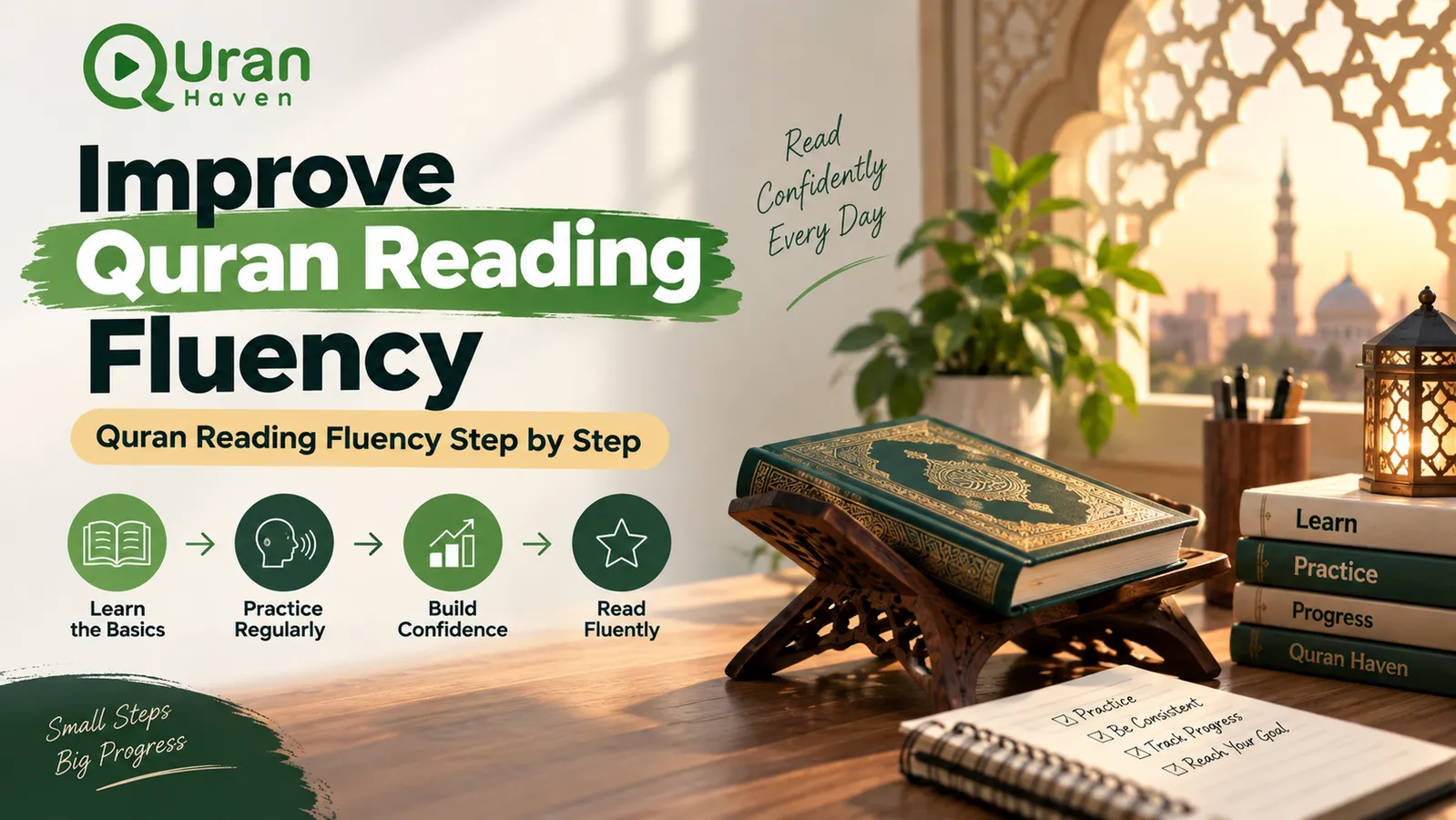
Learning how to improve Quran reading fluency takes more than simply trying to read faster. True fluency develops when you can recognize Arabic letters and words accurately, apply vowel marks correctly, pronounce letters clearly, and move through Quranic text with fewer unnecessary pauses.
A beginner may know the Arabic alphabet and still read very slowly.
Another student may recognize words quickly but make frequent pronunciation mistakes.
Someone else may read familiar Surahs smoothly but struggle when opening an unfamiliar page.
All of these situations are normal.
Quran reading fluency develops gradually through accurate repetition, consistent practice, correction, and exposure to different Quranic passages.
The goal is not to rush.
The goal is to make correct reading increasingly natural.
This guide explains a practical step-by-step system for improving Quran reading fluency while protecting accuracy and pronunciation.
What Does Quran Reading Fluency Mean?
Quran reading fluency means being able to read Quranic Arabic with increasing smoothness, accuracy, and confidence.
A fluent reader does not need to stop after every letter to decode the word.
Instead, familiar letter patterns, vowel marks, and common Quranic words are recognized more quickly.
Fluency includes several skills working together
Accurate letter recognition.
Correct Harakat.
Recognition of Sukoon and Shaddah.
Understanding joined letter forms.
Clear pronunciation.
Smooth word transitions.
Basic Tajweed application.
Appropriate stopping and starting.
The ability to read unfamiliar passages.
Reading speed is only one part of fluency.
If speed increases while accuracy decreases, the reading has not truly improved.
Accuracy Comes Before Speed
One of the biggest mistakes beginners make is trying to sound fluent before their foundation is stable.
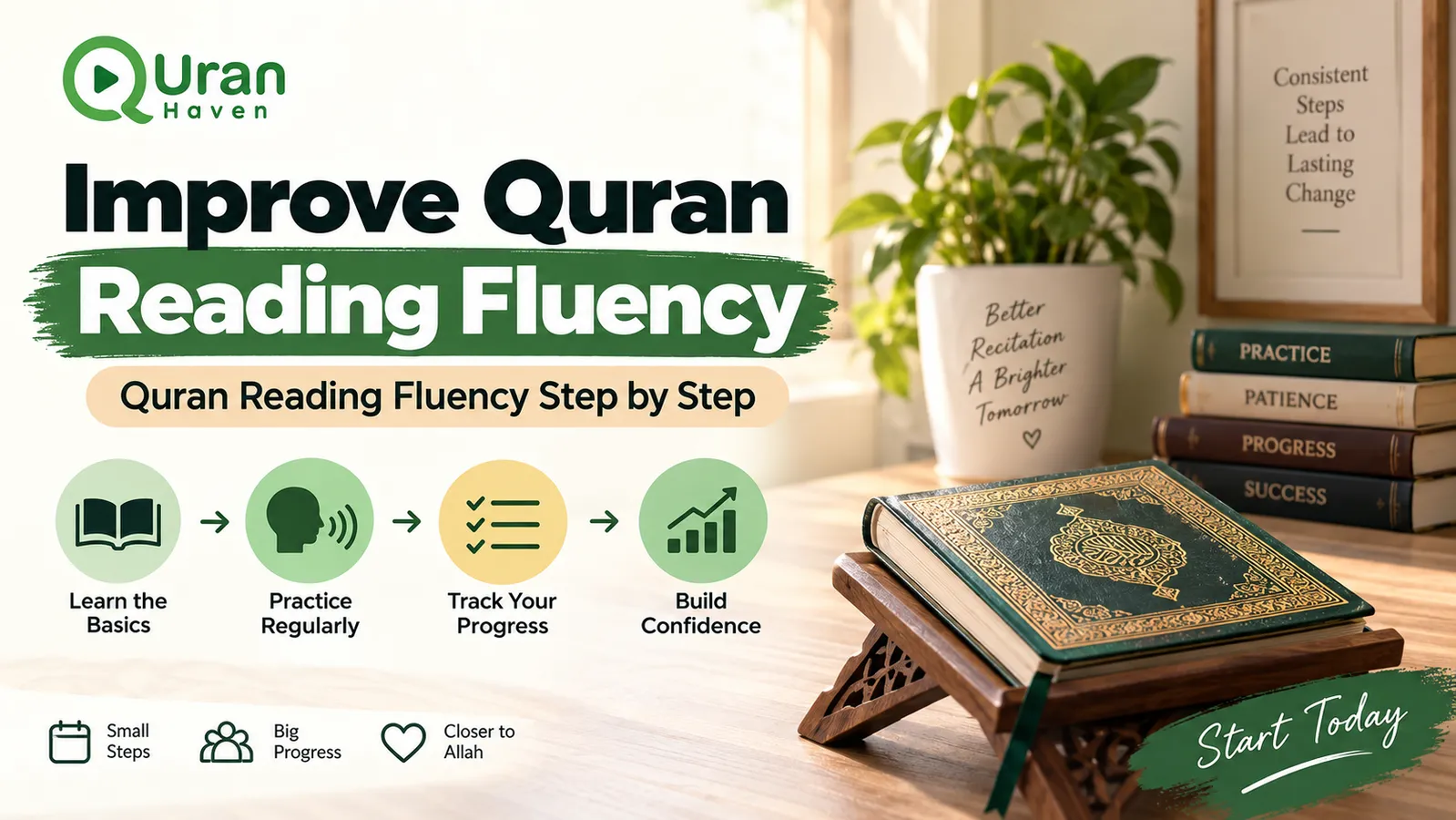
A student may rush because slow reading feels uncomfortable.
This often causes problems such as
Missing vowel marks.
Confusing similar letters.
Skipping Shaddah.
Adding sounds that are not written.
Removing sounds.
Guessing words.
Incorrect word endings.
Poor pronunciation.
Instead of forcing speed, slow down enough to read correctly.
When correct reading becomes repeated and familiar, speed can increase naturally.
Think of fluency as the result of accuracy practiced many times.
Step 1: Strengthen Arabic Letter Recognition
If you frequently hesitate when identifying Arabic letters, fluency will remain difficult.
Your eyes need to recognize letters quickly whether they appear
Alone.
At the beginning of a word.
In the middle.
At the end.
Practice letters in random order.
Pay particular attention to groups with similar shapes.
Do not depend only on remembering the alphabet sequence.
You should be able to see a letter inside a Quranic word and identify it immediately.
The faster accurate recognition becomes, the less mental effort you need for basic decoding.
Step 2: Review the Basic Harakat
Fatha, Kasra, and Damma appear constantly in Arabic reading.
A fluent reader does not pause to consciously identify each mark by name.
The reader sees the letter and vowel combination and produces the sound.
Practice mixed combinations until this response becomes more automatic.
For example, use different letters with different Harakat in random order.
Avoid practicing only predictable sequences.
Your goal is immediate recognition.
Step 3: Strengthen Sukoon, Shaddah, and Tanween
Many students can read basic vowel combinations but slow down when additional marks appear.
Sukoon requires you to connect sounds without adding an extra vowel.
Shaddah requires a doubled consonant sound.
Tanween introduces common word endings.
If these marks still cause frequent hesitation, isolate them for additional practice.
Fluency improves when the individual components of Quran reading no longer require excessive conscious effort.
Step 4: Improve Recognition of Joined Arabic Letters
Arabic letters change shape when connected.
A beginner may recognize a letter alone but fail to identify it inside a word.
Take Quranic words and separate them visually into their component letters.
Ask
What is the first letter?
What is the middle letter?
What is the final letter?
Which marks belong to each letter?
Then read the whole word.
Over time, you will stop needing to consciously break down every familiar word.
This is an important stage in learning how to read the Quran for beginners and later developing stronger fluency.
Step 5: Practice Common Quranic Words
The Quran contains many words and patterns that appear repeatedly.
The more frequently you encounter the same structures, the easier recognition becomes.
Create a small list of Quranic words that you see often.
Read them repeatedly.
But do not memorize only their visual appearance.
Make sure you can still identify
The letters.
The vowel marks.
The pronunciation.
The word ending.
When these common words appear inside a verse, you should gradually recognize them with less hesitation.
Step 6: Stop Guessing Difficult Words
Guessing can make reading appear faster temporarily, but it damages accuracy.
When you meet an unfamiliar Quranic word, resist the temptation to predict it from the first few letters.
Instead
Pause.
Identify every letter.
Check the vowel marks.
Notice Sukoon or Shaddah.
Identify any long vowel.
Read the word slowly.
Then repeat it.
Correct decoding strengthens future fluency.
Guessing strengthens bad habits.
Step 7: Read Aloud Every Day
Fluency is not only visual.
You need to coordinate your eyes, tongue, breathing, and hearing.
Read aloud at a comfortable volume.
This allows you to hear
Unclear pronunciation.
Frequent hesitation.
Repeated errors.
Awkward transitions.
Added sounds.
Missing sounds.
Silent reading can support recognition, but aloud reading should be a regular part of Quran reading practice for beginners.
Step 8: Use Repeated Reading
Repeated reading is one of the most effective ways to build fluency.
Choose a short passage.
Read it slowly once.
Correct mistakes.
Read it again.
Then read it a third time.
You may notice that the second and third readings become smoother because the words are now familiar.
A simple method is
First reading — focus completely on accuracy.
Second reading — focus on smoother transitions.
Third reading — maintain accuracy while reading more naturally.
Do not force the third reading to become extremely fast.
The goal is smoother reading, not racing.
Step 9: Repeat Difficult Words Separately
If one word repeatedly interrupts your reading, do not keep restarting the entire page.
Isolate the difficult word.
Read it slowly.
Break it into smaller sound units if necessary.
Repeat it several times.
Then read the phrase containing the word.
Finally, return to the complete verse.
This targeted practice saves time and directly addresses the source of hesitation.
Step 10: Practice Transitions Between Words
Sometimes individual words are easy, but the transition from one word to another causes difficulty.
Practice the final part of the first word together with the beginning of the next.
Repeat the two-word combination several times.
Then return to the complete verse.
Smooth transitions are one of the differences between basic decoding and more fluent Quran reading.
Step 11: Listen to Accurate Quran Recitation
Listening can support fluency when used correctly.
Choose a reliable reciter.
Follow the written text while listening.
Pay attention to
Pronunciation.
Long sounds.
Word endings.
Pauses.
Transitions.
Then stop the audio.
Read the same passage yourself.
Do not simply repeat the melody from memory.
Keep your eyes on the Arabic text and actively read.
Listening should support your reading skill, not replace it.
Step 12: Read With a Qualified Quran Teacher
Self-practice is essential, but you may not notice every mistake.
A qualified Quran teacher can identify problems such as
Incorrect Makharij.
Confusion between similar letters.
Incorrect Harakat.
Tajweed mistakes.
Added or missing sounds.
Poor stopping.
Repeated hesitation.
Regular Quran recitation correction can prevent errors from becoming permanent habits.
This is especially important when you are trying to increase speed.
A teacher can tell you whether your fluency is improving without sacrificing accuracy.
Step 13: Record Yourself Reading Quran
Voice recording is a useful self-assessment tool.
Choose a short passage.
Read it without stopping the recording every time you make a mistake.
Then listen back.
You may notice things you did not recognize during the reading itself.
For example
Long pauses.
Repeated filler sounds.
Uneven speed.
A letter that is regularly mispronounced.
A word that causes hesitation every time.
Compare the recording with an accurate recitation and the Mushaf.
Use the results to choose what to practice next.
Step 14: Read Familiar and Unfamiliar Passages
If you only read Surahs you already know by memory, your reading may appear more fluent than it actually is.
Part of the recitation may come from memory rather than active reading.
Include both
Familiar passages.
Unfamiliar passages.
Familiar passages help you practice smoothness.
Unfamiliar passages test your actual decoding ability.
Both are useful.
Step 15: Use Short Daily Reading Sessions
You do not need a very long session to improve fluency.
Consistency matters more.
A practical daily routine might be
5 minutes — review a weak reading skill.
15 minutes — read Quran aloud.
5 minutes — repeat difficult words.
5 minutes — listen and correct pronunciation.
This creates a 30-minute session.
If you only have 15 minutes, use
10 minutes of active reading.
5 minutes of correction.
Regular short sessions can produce better results than occasional long practice.
A 20-Minute Quran Reading Fluency Routine
Try this structure
First 5 minutes
Read a familiar passage slowly.
Next 10 minutes
Read an unfamiliar or less familiar passage.
Final 5 minutes
Repeat the most difficult words and transitions.
This combines confidence-building with real reading practice.
A 30-Minute Fluency Routine
For a longer session
5 minutes — warm-up with familiar Quranic words.
10 minutes — new passage.
5 minutes — difficult words.
5 minutes — repeated reading.
5 minutes — pronunciation correction.
Adjust the routine according to your current weaknesses.
Step 16: Track the Type of Mistakes You Make
Do not simply count mistakes.
Identify patterns.
For example
Letter-recognition mistake.
Harakah mistake.
Shaddah mistake.
Pronunciation mistake.
Word-ending mistake.
Long-vowel mistake.
Hesitation.
Incorrect stopping.
If most of your errors come from one area, focus your practice there.
This is more effective than repeating everything equally.
Step 17: Work on Similar-Looking Letters
Arabic contains several letters with similar written forms.
If you confuse them, reading slows down because you need extra time to identify the correct letter.
Practice similar groups separately.
Pay attention to
Number of dots.
Position of dots.
Exact shape.
Sound.
Then find examples inside Quranic words.
The goal is immediate recognition without guessing.
Step 18: Improve Makharij Gradually
A reader may become visually fluent while still pronouncing certain letters incorrectly.
Do not separate fluency from pronunciation.
Work gradually on Makharij.
Choose one difficult letter or group at a time.
Listen to the correct sound.
Practice it alone.
Practice it with vowels.
Practice it inside words.
Then practice it in Quranic verses.
This prevents pronunciation training from becoming overwhelming.
Step 19: Add Basic Tajweed Gradually
You do not need to master every advanced Tajweed rule before working on fluency.
However, correct Quran reading eventually requires applying Tajweed appropriately.
Introduce rules gradually.
Learn one rule.
Find examples.
Practice it in short passages.
Apply it during normal reading.
Then continue to the next skill.
Fluency and Tajweed should develop together rather than competing with each other.
Step 20: Practice Appropriate Stops
Fluency does not mean reading continuously without stopping.
Breathing and stopping are part of recitation.
Beginners sometimes stop in awkward places because they run out of breath.
Others rush to avoid stopping.
Learn to notice appropriate stopping points.
Plan your breath.
Do not force yourself to complete a long verse if your breath becomes unstable.
A teacher can help you improve this skill.
Why Reading the Same Page Helps
Repeatedly reading the same page can improve
Word recognition.
Confidence.
Pronunciation.
Transitions.
Reading rhythm.
However, do not spend all your practice on one page.
Once a passage becomes comfortable, test yourself with unfamiliar material.
True fluency should gradually transfer to new Quranic text.
Why Unfamiliar Pages Are Important
An unfamiliar page shows you whether your reading skill is becoming independent.
When reading new material, ask
Can I recognize the letters?
Can I apply the marks correctly?
Can I decode long words?
Can I continue without guessing?
Do I maintain pronunciation?
The goal is not to read the unfamiliar page quickly.
The goal is to read it accurately with increasing independence.
How Many Pages Should You Read Every Day?
There is no universal number.
A beginner may benefit more from reading half a page carefully than reading five pages with repeated errors.
Choose an amount that allows you to
Read attentively.
Correct mistakes.
Repeat difficult words.
Maintain consistent practice.
As your fluency improves, you can gradually increase the amount.
Should You Time Your Quran Reading?
Timing can sometimes help you observe improvement, but it should be used carefully.
For example, you might record how long it takes to read the same short passage accurately at the beginning and after several weeks of practice.
But never sacrifice accuracy just to reduce the time.
A faster reading with more mistakes is not progress.
Use timing only as a secondary measure.
How to Know Your Quran Reading Fluency Is Improving
Look for signs such as
Less hesitation.
Faster letter recognition.
Fewer basic Harakah mistakes.
Smoother connected words.
More confident pronunciation.
Fewer repeated corrections.
Improved reading of unfamiliar passages.
Longer phrases without unnecessary stops.
More consistent application of basic Tajweed.
These indicators are more useful than simply counting how many pages you read.
Common Mistakes That Slow Quran Reading Fluency
Trying to Read Too Fast
Rushing creates errors and prevents good habits from becoming stable.
Practicing Only Once or Twice Per Week
Long gaps reduce familiarity.
Short daily practice is usually easier to maintain.
Reading Only Familiar Surahs
This can hide weaknesses because memory supports the recitation.
Ignoring Difficult Words
Weak words should be isolated and practiced.
Depending on Transliteration
Transliteration may provide temporary support but does not develop independent Arabic reading.
Reading Silently All the Time
Fluent Quran recitation requires spoken practice.
Ignoring Pronunciation Errors
Speed should never replace correct pronunciation.
Never Reviewing Corrections
A corrected mistake needs repetition before the new version becomes stable.
Changing Learning Methods Constantly
Choose a structured method and follow it consistently.
What If You Still Read Very Slowly?
Slow reading is normal during the learning process.
Ask why you are slow.
Do you hesitate because of
Letter recognition?
Harakat?
Connected letters?
Shaddah?
Long vowels?
Pronunciation?
Unfamiliar words?
Once you identify the main reason, practice that skill directly.
Do not simply tell yourself to “read faster. ”
Solve the source of the hesitation.
What If You Can Read but Make Many Mistakes?
Reduce your speed.
Return to accuracy.
Keep a list of repeated mistakes.
Read shorter sections.
Receive teacher correction.
Then gradually increase smoothness again.
Fluency built on repeated mistakes is difficult to repair later.
What If You Read Accurately but Very Slowly?
This is actually a strong foundation.
Use repeated reading to increase automatic recognition.
Read the same short passage several times.
Practice common Quranic words.
Increase daily exposure.
Over time, your brain will need less effort to decode familiar patterns.
Your speed can improve without deliberately rushing.
How Long Does It Take to Improve Quran Reading Fluency?
The timeline differs from person to person.
It depends on
Your starting level.
Arabic familiarity.
Daily practice.
Teacher feedback.
Pronunciation.
Reading frequency.
Consistency.
Some students notice clear improvement within weeks of daily practice.
Developing strong, confident Quran reading may take considerably longer.
Focus on steady progress instead of an exact deadline.
A Four-Week Fluency Improvement Plan
Week 1
Strengthen letters, Harakat, Sukoon, and Shaddah.
Week 2
Practice connected words and common Quranic vocabulary.
Week 3
Read short verses repeatedly and correct pronunciation.
Week 4
Read longer and unfamiliar passages while maintaining accuracy.
At the end of four weeks, compare a new recording with one from the beginning.
Listen for
Fewer pauses.
Clearer pronunciation.
Better word recognition.
Smoother transitions.
More confidence.
Continue the same process during the next month.
How a Teacher Can Accelerate Improvement
A teacher helps you avoid practicing errors repeatedly.
Instead of spending weeks wondering why a word sounds wrong, you can receive immediate correction.
A teacher can also choose exercises based on your specific problem.
If your issue is Makharij, the lesson can focus on pronunciation.
If your problem is slow decoding, the lesson can focus on connected words.
If your problem is Tajweed, correction can target those rules.
Personal feedback makes practice more efficient.
Online Quran Reading Practice
Online Quran learning can be useful for students who do not have easy access to a local teacher.
A live teacher can listen to your reading and provide immediate feedback.
Between lessons, continue practicing independently.
A useful cycle is
Teacher lesson.
Correction.
Independent repetition.
Daily reading.
Next teacher lesson.
Testing.
This combines guidance with consistent personal practice.
Fluency Is Built Through Consistency
A student may read very well during one long weekend session but make little progress if the Quran is not opened again for several days.
Regular exposure helps visual recognition and pronunciation become familiar.
Even a manageable daily routine is valuable.
For example
20 minutes each day.
Six days per week.
One teacher session or correction session.
A weekly review of weak words.
This is easier to sustain than an unrealistic plan that requires several hours every day.
Do Not Compare Your Reading Speed With Others
Different students begin from different levels.
One person may speak Arabic.
Another may be seeing Arabic script for the first time.
One student may have studied Quran as a child.
Another may be an adult beginner.
Measure your improvement against your own previous reading.
Ask
Am I hesitating less than last month?
Are my mistakes decreasing?
Can I read unfamiliar words more independently?
Is my pronunciation improving?
That is meaningful progress.
Final Thoughts
Learning how to improve Quran reading fluency is a gradual process built on accuracy, repetition, correction, and consistency.
Do not begin by trying to read as quickly as possible.
Begin by reading correctly.
Strengthen your Arabic letters.
Master the vowel marks.
Recognize connected forms.
Practice Sukoon, Shaddah, Tanween, and long vowels.
Read aloud every day.
Repeat short passages.
Isolate difficult words.
Listen to accurate recitation.
Practice unfamiliar passages.
Record yourself.
And receive Quran recitation correction from a qualified teacher whenever possible.
As correct reading becomes more familiar, hesitation can decrease naturally.
Your eyes recognize patterns faster.
Your tongue moves between words more smoothly.
Your pronunciation becomes more confident.
And Quran reading gradually becomes easier.
The goal is not simply faster reading.
The goal is accurate, confident, and increasingly fluent recitation.