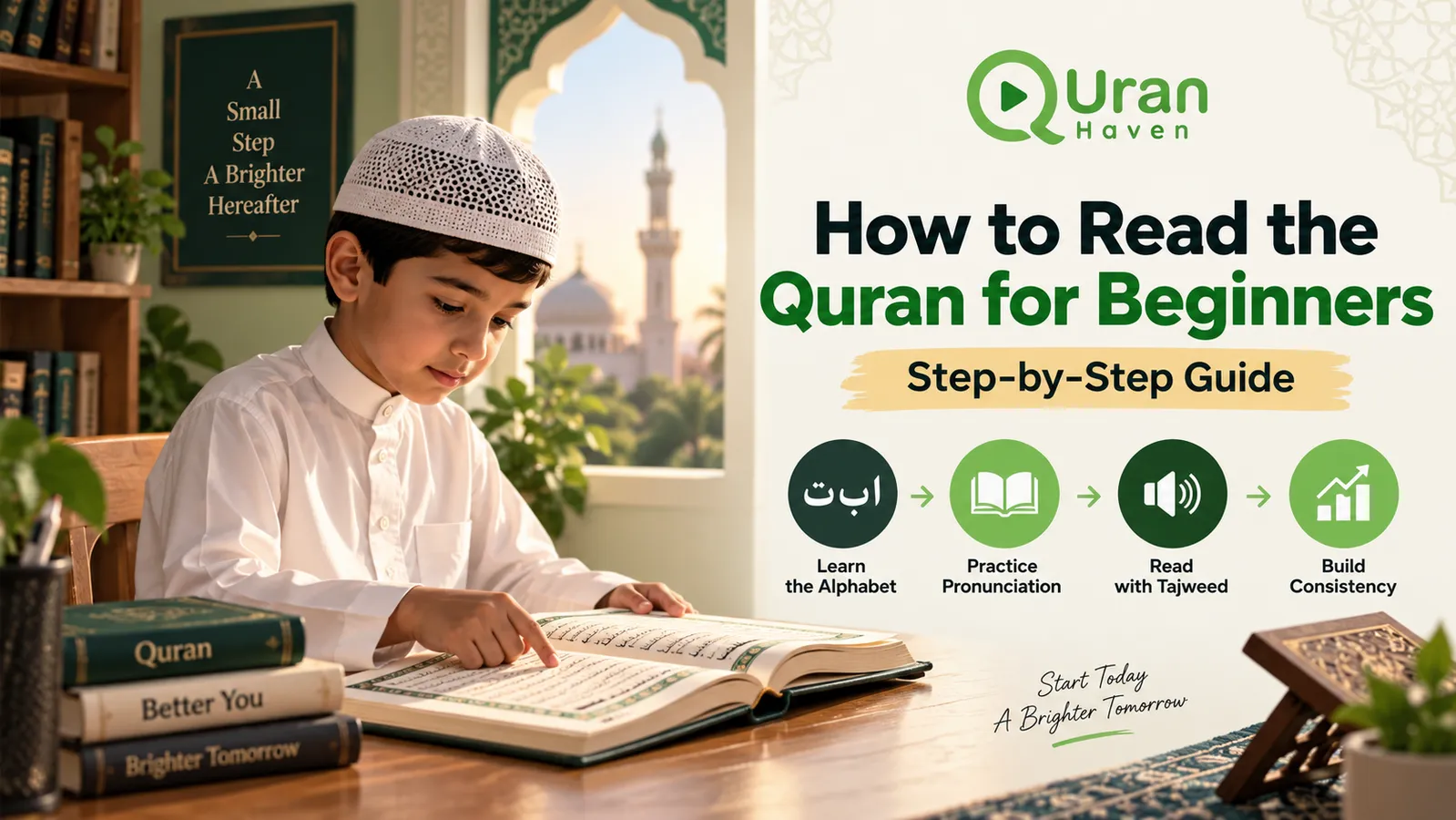
Learning how to read the Quran for beginners can feel challenging at first, especially if Arabic is not your first language. The letters may look unfamiliar, their shapes can change when they join together, and Quranic reading includes vowel marks and pronunciation rules that may be completely new to you.
The good news is that Quran reading can be learned step by step.
You do not need to understand every Arabic word before beginning to read. You also do not need to master advanced Tajweed rules immediately.
A beginner can start with the foundations
Recognizing Arabic letters.
Learning their sounds.
Understanding basic vowel marks.
Joining letters into words.
Reading simple Quranic words.
Practicing short verses.
Improving pronunciation.
Building fluency gradually.
This guide explains a practical path for learning Quran reading from the beginning.
Start With the Arabic Alphabet
The first step is becoming familiar with the Arabic alphabet.
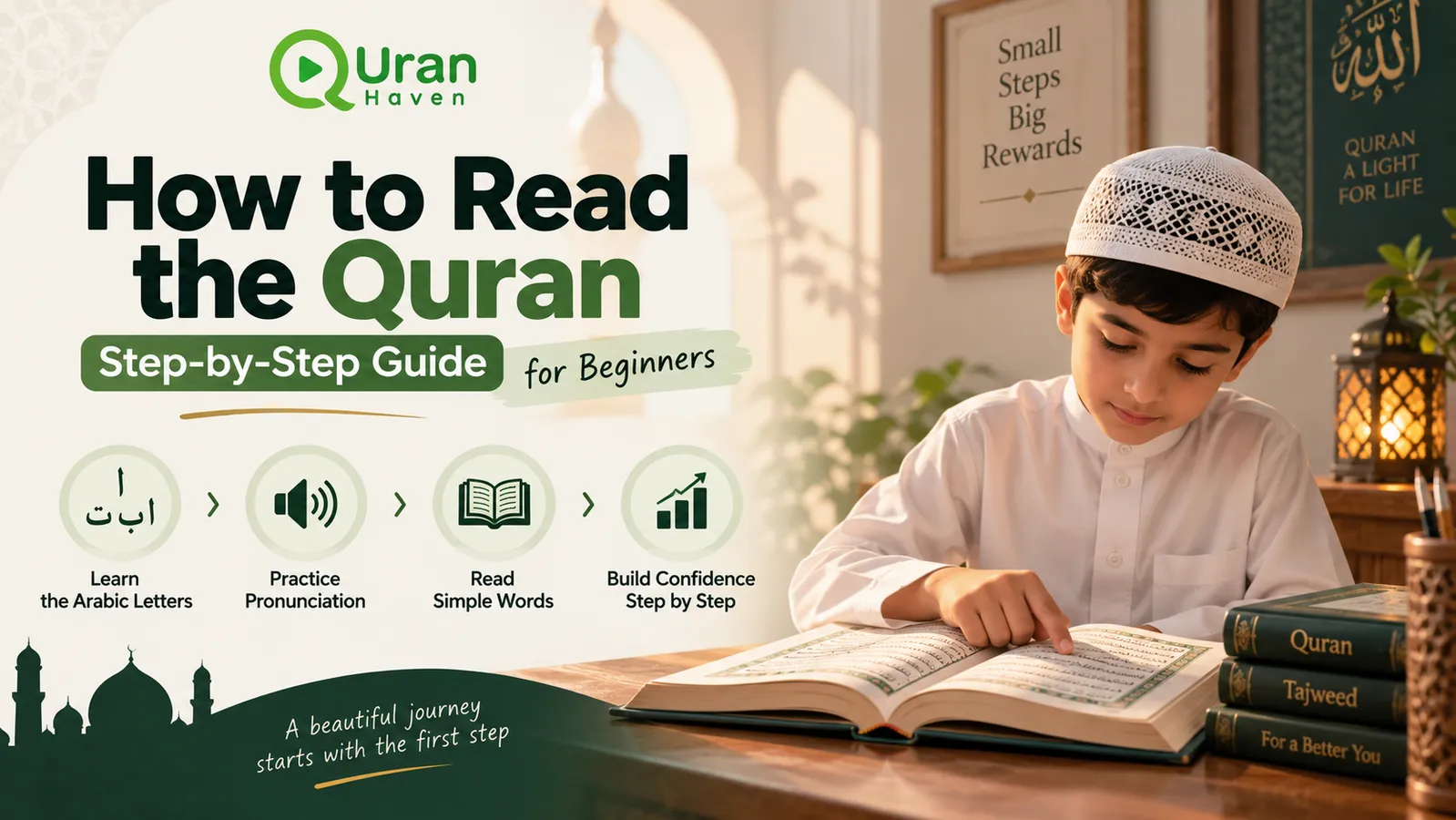
Arabic contains letters that may be completely new to an English-speaking learner.
Before trying to read full Quran verses, learn to recognize each letter and connect it with its basic sound.
Your early goal should be to look at a letter and recognize it without long hesitation.
For example, beginners should gradually become comfortable identifying letters such as:
Alif.
Ba.
Ta.
Tha.
Jeem.
Ha.
Kha.
And the remaining Arabic letters.
Do not rush through the alphabet simply because you can recite the letter names in order.
You should also be able to recognize letters when they appear individually and later when they appear inside words.
Learn the Sound of Each Arabic Letter
Knowing the name of a letter is different from pronouncing it correctly.
Some Arabic sounds do not have an exact equivalent in English.
For example, beginners may find certain throat letters or emphatic letters difficult.
This is why listening and correction are important.
When learning a new letter
Listen to its correct pronunciation.
Watch how a qualified teacher pronounces it.
Repeat the sound slowly.
Avoid adding unnecessary vowels.
Compare similar letters carefully.
Small pronunciation differences matter when reading the Quran.
Learning the sound correctly from the beginning can prevent repeated errors later.
Understand That Arabic Letters Change Shape
Arabic is written from right to left.
Many Arabic letters also change their written shape depending on whether they appear:
Alone.
At the beginning of a word.
In the middle.
At the end.
This can initially confuse beginners.
You may know a letter when it appears alone but fail to recognize it inside a connected word.
Practice each letter in different positions.
Your goal is to recognize the identity of the letter even when its appearance changes slightly.
This skill is essential before fluent Quran reading becomes possible.
Learn the Short Vowels
Once you recognize the letters, begin learning the basic short vowel marks.
The three fundamental Harakat are
Fatha.
Kasra.
Damma.
Fatha generally produces a short “a” sound.
Kasra generally produces a short “i” sound.
Damma generally produces a short “u” sound.
For example, instead of seeing a consonant alone, you begin reading combinations such as:
Ba with Fatha.
Ba with Kasra.
Ba with Damma.
Practice this with every letter.
This stage is important because Quran reading depends on recognizing both the letter and the mark attached to it.
Practice Harakat Until Recognition Becomes Automatic
A common beginner mistake is learning the vowel marks once and immediately moving to longer words.
Instead, repeat them until you can identify them quickly.
Practice combinations such as
Letter + Fatha.
Letter + Kasra.
Letter + Damma.
Mix them randomly rather than always practicing them in the same order.
The goal is to reduce hesitation.
When basic letter-and-vowel combinations become easier, reading words becomes much less overwhelming.
Learn Sukoon
Sukoon indicates that a letter does not carry a short vowel sound.
This introduces beginners to combinations where one sound connects directly to another.
For example, instead of reading every consonant with a separate vowel, you begin joining sounds more naturally.
Sukoon requires careful practice because beginners may accidentally add an extra vowel to the letter.
Listen to examples and repeat them accurately.
Learn Shaddah
Shaddah indicates emphasis or doubling of a consonant.
Beginners sometimes overlook it and read the letter only once.
That changes the pronunciation.
Practice recognizing Shaddah visually and producing the stronger doubled sound correctly.
Do not treat it as a decorative mark.
It directly affects how the word is read.
Learn Tanween
Tanween introduces endings commonly represented by
Fathatain.
Kasratain.
Dammatain.
These marks appear frequently in Quranic Arabic.
Practice them after you are comfortable with the basic short vowels.
Again, focus first on recognition and correct sound rather than speed.
Learn Long Vowels
After becoming comfortable with short vowels, learn the common long vowel patterns.
Beginners need to recognize when a vowel should be extended rather than pronounced briefly.
This is an important bridge between basic Arabic decoding and accurate Quran reading.
Listen carefully to correct examples.
Avoid guessing the length based on English pronunciation.
Learn How Arabic Letters Join
Reading isolated letters is only the beginning.
The next major step is joining letters into complete words.
Arabic writing connects many letters together.
At first, a connected word may look like one complicated shape.
Train yourself to break the word into its individual letters.
Then identify the vowel marks.
Then blend the sounds together.
For example, approach a new word like this
Identify the first letter.
Identify its vowel.
Identify the next letter.
Notice whether it carries Sukoon, Shaddah, or another mark.
Continue until the entire word is decoded.
With practice, you will stop needing to consciously separate every letter.
Start With Short Arabic Words
Do not begin with long and difficult Quranic words if you are still struggling with basic decoding.
Practice short words first.
The goal is to develop confidence in
Recognizing letters.
Applying Harakat.
Joining sounds.
Reading from right to left.
Maintaining correct pronunciation.
Once short words become comfortable, gradually move to longer words.
This progression is more effective than repeatedly struggling with material far above your current reading level.
Use a Structured Beginner Method
Many Quran teachers use beginner reading methods that introduce Arabic reading gradually.
These may include approaches based on Qaida or structured reading books.
Different programs may organize the lessons differently, but a useful beginner curriculum should normally progress from simple to complex.
For example
Arabic letters.
Letter sounds.
Harakat.
Joined letters.
Sukoon.
Shaddah.
Tanween.
Long vowels.
Quranic words.
Short verses.
Choose one structured method and follow it consistently instead of moving randomly between lessons.
Read With a Quran Teacher When Possible
One of the most valuable things a beginner can do is read aloud to a qualified teacher.
When learning independently, you may pronounce something incorrectly without realizing it.
A teacher can immediately identify
Incorrect letter pronunciation.
Confusion between similar letters.
Incorrect vowels.
Added sounds.
Missing sounds.
Incorrect word endings.
Basic Tajweed issues.
Regular correction helps prevent mistakes from becoming habits.
Online Quran lessons can also provide this feedback when an in-person teacher is not available.
Do Not Wait Until Your Reading Is Perfect Before Practicing
Beginners sometimes become afraid to read because they make mistakes.
But reading improves through practice and correction.
Your early reading will naturally be slow.
You may stop after almost every letter.
You may need to repeat the same word several times.
That is normal at the beginning.
The goal is not immediate speed.
The goal is accurate improvement.
Practice Reading Aloud
Silent recognition alone is not enough for Quran reading.
Read aloud at a comfortable volume.
This allows you to hear your own pronunciation.
You may notice that a word looked correct in your mind but became difficult when spoken.
Reading aloud helps develop coordination between
Visual recognition.
Pronunciation.
Breathing.
Word transitions.
Listening to yourself.
A teacher can also correct you more easily when you read aloud.
Use Listening as a Learning Tool
Listening to accurate Quran recitation can support beginner reading.
Choose the passage you are studying.
Follow the text visually while listening.
Notice how each word is pronounced.
Pause the recording.
Repeat the word or verse yourself.
Then compare again.
Listening is especially useful for pronunciation and rhythm.
However, listening should support active reading rather than replace it.
You still need to look at the text and decode the words yourself.
Avoid Memorizing the Sound Without Reading the Letters
A beginner may repeatedly listen to a short Surah until it becomes memorized.
Then when looking at the Mushaf, the student may appear to be reading while actually reciting from memory.
To develop real reading ability, practice unfamiliar or less familiar words too.
Point to the text.
Identify the letters.
Read the vowel marks.
Decode the word.
This confirms that your reading skill is improving rather than only your memory.
Practice Every Day
Daily Quran reading practice does not need to be very long.
Consistency is more important than occasional long sessions.
A beginner might start with
15 minutes of letter or reading practice.
10 minutes of teacher-guided reading.
5 minutes reviewing difficult words.
Even twenty focused minutes every day can create a strong habit.
Try to avoid practicing for two hours once and then doing nothing for the rest of the week.
Regular contact with Arabic writing helps recognition become faster.
A Simple 20-Minute Beginner Quran Reading Routine
You can organize a short daily session like this
First 5 minutes
Review letters, Harakat, or the reading rule you are currently learning.
Next 10 minutes
Read new words or several lines slowly.
Final 5 minutes
Repeat the words that caused difficulty.
If you have a teacher, keep a list of mistakes to review before your next lesson.
A 30-Minute Quran Reading Routine
If you have more time
5 minutes — review previous material.
10 minutes — practice the current reading skill.
10 minutes — read Quranic words or verses.
5 minutes — repeat difficult pronunciation.
The exact timing is flexible.
What matters is maintaining a clear structure.
Focus on Accuracy Before Speed
Beginners often want to read Quran quickly.
But speed should develop from familiarity and accuracy.
If you rush, you may
Skip vowel marks.
Misidentify letters.
Add sounds.
Remove sounds.
Read incorrect word endings.
Develop pronunciation habits that later need correction.
Slow reading is acceptable while learning.
Read carefully.
Speed will naturally improve as recognition becomes more automatic.
Learn the Difference Between Similar Arabic Letters
Several Arabic letters have similar written forms.
Others have sounds that may seem similar to beginners.
Confusing these letters can change words completely.
Spend extra time comparing difficult pairs or groups.
Look at
The number of dots.
The position of dots.
The shape.
The articulation point.
The sound.
Do not rely only on visual memory.
Pronunciation practice should accompany letter recognition.
Pay Attention to Makharij
Makharij refers to where Arabic letters are articulated.
You do not need to master advanced Tajweed terminology before beginning Quran reading, but correct articulation is important.
Some letters come from
The throat.
The tongue.
The lips.
Other specific articulation areas.
If two letters sound identical when they should not, ask a teacher for correction.
Learning clear letter distinctions early makes future Quran reading easier.
When Should Beginners Start Tajweed?
You can begin learning basic correct pronunciation from the beginning.
However, you do not need to memorize every advanced Tajweed rule before you can start reading.
A practical progression is
Learn to recognize letters.
Learn their correct sounds.
Learn vowels and joining.
Develop basic reading ability.
Gradually introduce Tajweed rules.
Apply them during reading practice.
This prevents the beginner from becoming overwhelmed while still protecting correct recitation.
Start Reading Short Surahs
Once you can decode basic Quranic words, begin practicing short Surahs.
Short passages allow you to focus on
Accurate reading.
Word recognition.
Verse endings.
Pronunciation.
Basic Tajweed.
Fluency.
Read slowly.
Do not worry if one short Surah takes several sessions.
Accuracy is more important than finishing quickly.
Repeat the Same Passage
Repeated reading helps develop fluency.
For example
Read the first verse slowly.
Correct mistakes.
Read it again.
Then read the next verse.
Connect both verses.
Return to the passage the following day.
You may notice that the same words become easier each time.
This is how reading fluency develops.
Keep a List of Difficult Words
During Quran reading practice, certain words may repeatedly cause problems.
Write them down.
Your list might contain
Words with difficult letter combinations.
Words containing Shaddah.
Long-vowel patterns.
Similar-looking letters.
Words where you repeatedly use the wrong vowel.
Practice these words separately.
Then return them to their original verse.
This focused correction can be more effective than repeatedly rereading an entire page.
Do Not Guess Unfamiliar Words
If you see a difficult word, slow down.
Do not guess based on its general appearance.
Break it down.
Identify
The letters.
The dots.
The vowel marks.
Sukoon.
Shaddah.
Long vowels.
Then read the word carefully.
Guessing may create incorrect habits.
Use the Mushaf Consistently
Beginners can benefit from practicing with a consistent Mushaf style.
Repeated exposure to the same script can make visual recognition easier.
However, the goal is ultimately to read Arabic itself, not merely memorize page shapes.
Focus on letters, marks, and words rather than only page location.
What If You Already Know the Arabic Alphabet but Cannot Read Quran?
This is common.
Knowing isolated Arabic letters does not automatically mean you can read connected Quranic text.
You may need additional practice with
Joined letter forms.
Harakat.
Sukoon.
Shaddah.
Tanween.
Long vowels.
Word blending.
Quranic script.
Start at the point where your ability becomes uncertain.
There is no need to repeat material you already know well, but do not skip foundational skills that are still weak.
What If You Cannot Read Arabic at All?
Begin from the alphabet.
Do not feel pressured to start with full Quran pages.
Build the foundation carefully.
A practical sequence is
Letters.
Sounds.
Short vowels.
Joined letters.
Basic marks.
Words.
Short phrases.
Quran verses.
This path may initially feel slower, but it prepares you for more independent reading later.
How Long Does It Take to Learn Quran Reading?
There is no single timeline.
Progress depends on
Your current Arabic level.
Lesson frequency.
Daily practice.
Teacher support.
Pronunciation ability.
Consistency.
Some beginners progress quickly through the alphabet and basic reading.
Others need more time.
Avoid measuring your success only by how fast another student progresses.
Focus on steady improvement.
Common Quran Reading Mistakes Beginners Make
Skipping Vowel Marks
Beginners sometimes focus only on the letters and overlook the Harakat.
Read the complete written information.
Confusing Similar Letters
Pay attention to dots and articulation.
Adding Extra Vowels
This often occurs when reading letters with Sukoon.
Practice connecting sounds without inserting an unnecessary vowel.
Ignoring Shaddah
A Shaddah affects pronunciation and should not be skipped.
Rushing
Slow down when accuracy begins to decrease.
Depending Entirely on Transliteration
Transliteration may appear easier, but it cannot fully represent Arabic Quran pronunciation.
Use it only as temporary support if necessary while actively learning Arabic script.
Reading Without Correction
Regular teacher feedback can identify errors that are difficult to hear yourself.
How to Improve Quran Reading Fluency
Fluency grows through repeated accurate reading.
A practical method is
Choose a short passage.
Read it slowly.
Correct mistakes.
Read it again.
Listen to accurate recitation.
Read it again without the audio.
Return to the passage the following day.
Over time, familiar word patterns become easier to recognize.
Do not force speed.
Let fluency develop from accuracy and repetition.
Reading Quran Online as a Beginner
Online learning can be useful for beginners because you can study from home while receiving live correction.
A structured online Quran program can help you
Learn Arabic letters.
Practice pronunciation.
Read directly to a teacher.
Receive immediate corrections.
Progress through lessons at an appropriate level.
Develop a regular practice routine.
The quality of teaching and your own consistency matter more than whether the lesson is online or in person.
How Parents Can Help Beginner Children
Parents can support children by making Quran reading practice consistent and encouraging.
Keep sessions manageable.
Celebrate improvement.
Avoid comparing children.
Review teacher assignments.
Help maintain regular attendance.
Encourage correct pronunciation rather than rushing.
A positive learning environment can help children remain engaged.
Adults Can Learn Quran Reading Too
Quran reading is not only for children.
Adults frequently begin from the alphabet or return after years away from Arabic reading.
Adults may feel embarrassed about being beginners.
There is no reason to be.
Start from your actual level.
If you know only a few letters, begin there.
If you can read slowly but struggle with pronunciation, focus on correction.
If you read accurately but lack fluency, increase repeated reading practice.
The learning path can be adapted to your current ability.
A Practical Beginner Roadmap
Stage 1
Learn and recognize all Arabic letters.
Stage 2
Learn correct letter sounds.
Stage 3
Master Fatha, Kasra, and Damma.
Stage 4
Learn joined letter shapes.
Stage 5
Study Sukoon, Shaddah, Tanween, and long vowels.
Stage 6
Read short Arabic and Quranic words.
Stage 7
Read short Quran verses.
Stage 8
Practice complete short Surahs.
Stage 9
Introduce and strengthen Tajweed.
Stage 10
Increase regular Quran reading for fluency.
Do not worry if one stage takes longer than another.
Move forward when the foundation is reasonably stable.
How to Know You Are Improving
You may notice that
You recognize letters faster.
Connected words look less confusing.
You hesitate less often.
You make fewer vowel mistakes.
You can read longer phrases.
Your teacher corrects fewer basic errors.
You can read unfamiliar words more independently.
These are meaningful signs of progress.
Final Thoughts
Learning how to read the Quran for beginners becomes much easier when the process is divided into clear steps.
Start with Arabic letters.
Learn their correct sounds.
Master the basic vowel marks.
Practice connected letter forms.
Learn Sukoon, Shaddah, Tanween, and long vowels.
Move from individual sounds to words.
Then begin reading short Quranic verses and Surahs.
Practice regularly.
Read aloud.
Listen carefully.
Slow down when necessary.
And receive correction from a qualified Quran teacher whenever possible.
Do not measure your progress only by reading speed.
Accurate reading is the foundation.
As letter recognition and pronunciation become stronger, fluency can gradually follow.
A beginner does not need to master everything at once.
Take the Quran reading journey one skill, one word, and one verse at a time.