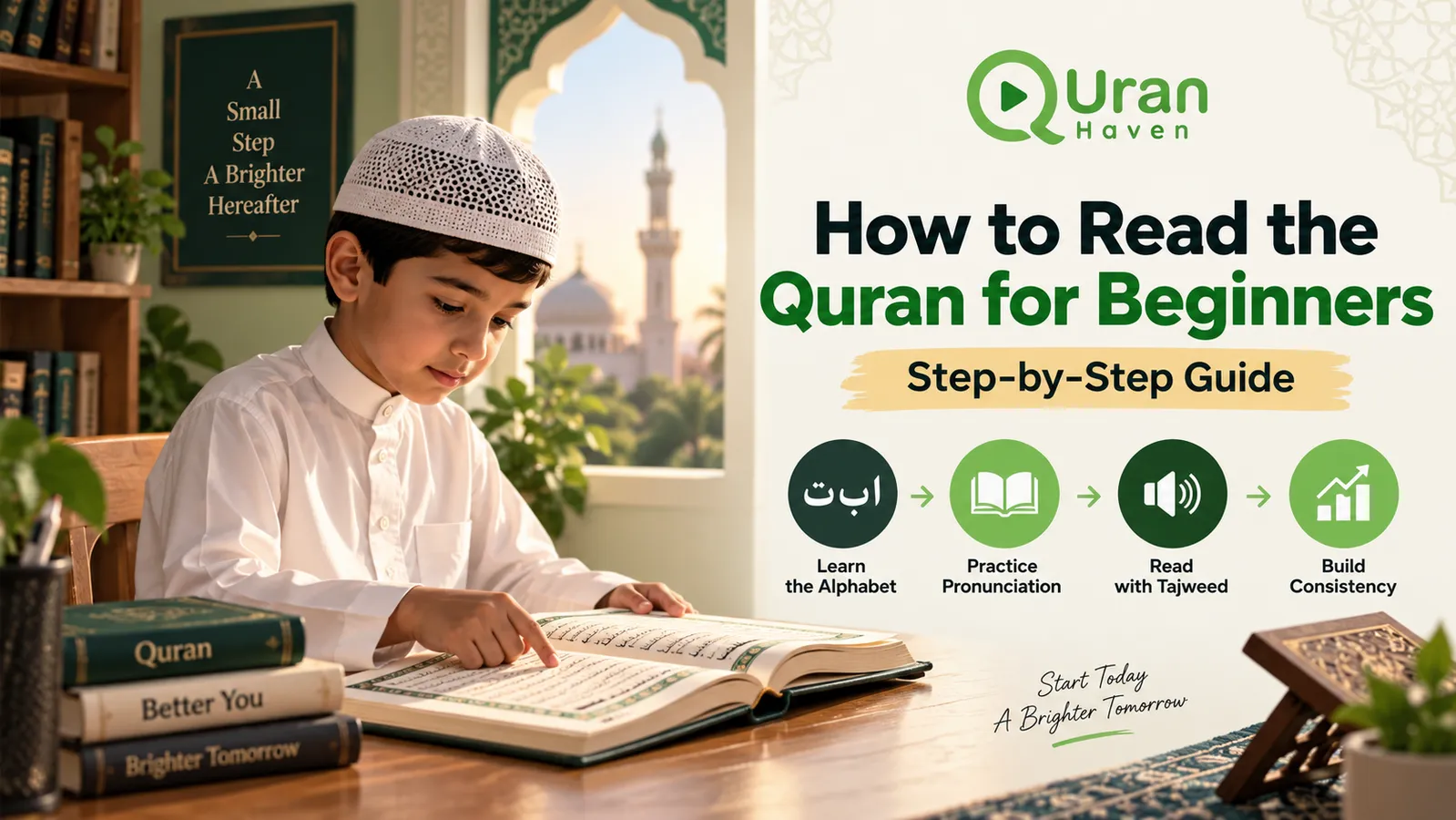
If you want to learn Quran online for beginners, your first lesson does not need to feel overwhelming. A structured beginner program should start by understanding what you already know and then build your Quran reading skills step by step.
Some beginners have never studied Arabic.
Others recognize the Arabic alphabet but cannot read connected words.
Some can read Quran slowly but make frequent pronunciation mistakes.
Others learned as children and now want to rebuild their reading skills as adults.
Because beginners start at different levels, a good online Quran course should not place every student into exactly the same lesson.
Your teacher should first identify your current ability and then create an appropriate learning path.
This guide explains what you can expect from your first online Quran lessons, how beginner classes usually work, what skills you may study, and how to make consistent progress between lessons.
What Happens in Your First Online Quran Lesson?
The first lesson is usually an opportunity for the teacher to understand your current level.
You should not feel pressured to demonstrate advanced Quran reading.
The purpose is assessment, not examination.
Your teacher may ask you to
Recognize Arabic letters.
Pronounce several letters.
Read letters with Fatha, Kasra, or Damma.
Read simple Arabic words.
Read a short Quranic passage.
Recite a Surah you already know.
Explain any previous Quran learning experience.
The teacher may also ask about your goals.
For example
Do you want to learn Quran reading from the beginning?
Do you want to improve pronunciation?
Do you want to study Tajweed?
Do you eventually want to memorize Quran?
Are you returning to Quran study after a long break?
These answers help determine where your lessons should begin.
You Do Not Need Previous Arabic Knowledge
Many people delay Quran lessons because they believe they must first learn Arabic independently.

That is not necessary.
A complete beginner can start with the Arabic alphabet.
Your first lessons may focus on
Recognizing letters.
Learning their sounds.
Distinguishing similar letters.
Understanding how Arabic is read from right to left.
Learning how letters change shape when connected.
You can develop Arabic reading skills gradually while studying Quran.
Speaking Arabic fluently is not required before beginning.
Your Teacher May Start With the Arabic Alphabet
If you are a complete beginner, your lessons may begin with individual Arabic letters.
The goal is not simply to memorize the alphabet in order.
You should learn to recognize each letter independently.
For every letter, your teacher may help you understand
Its shape.
Its name.
Its sound.
Its articulation.
Similar-looking letters.
How its shape changes when connected.
This creates the foundation for Quran reading.
If letter recognition remains weak, reading complete Quranic words becomes much harder later.
Pronunciation Correction Starts Early
Online Quran lessons should not focus only on visual reading.
Your teacher needs to hear you.
Arabic includes sounds that may be unfamiliar to non-Arabic speakers.
Some letters come from different areas of the throat, tongue, or lips.
Beginners may initially pronounce two different Arabic letters almost identically.
A teacher can demonstrate the correct sound and ask you to repeat it.
This early correction is important because repeated pronunciation mistakes can become habits.
Learning a letter correctly from the beginning is usually easier than correcting it after months of repetition.
You Will Learn Fatha, Kasra, and Damma
Once you recognize basic Arabic letters, you will begin learning the short vowel marks.
These are commonly called Harakat.
The basic three are
Fatha.
Kasra.
Damma.
Your teacher may show you the same Arabic letter with each mark so you can hear how the sound changes.
You will then practice different letters until you can recognize these combinations more quickly.
At first, you may need time to think about every symbol.
With repeated practice, recognition becomes more automatic.
Learning Connected Arabic Letters
Arabic letters are often connected inside words.
Their appearance can change depending on their position.
A letter may look slightly different when it occurs
At the beginning of a word.
In the middle.
At the end.
This is one of the main reasons a beginner may know the Arabic alphabet but still struggle to read Quranic text.
Online lessons should gradually train you to recognize these connected forms.
The teacher may break a word into individual letters and then show you how to blend the sounds together.
This process gradually develops independent reading ability.
Learning Sukoon
After basic vowels, you may begin working with Sukoon.
Sukoon indicates that a letter does not carry a short vowel.
Beginners sometimes accidentally add a vowel when reading a letter with Sukoon.
Your teacher can demonstrate how the sound connects from the previous letter.
You may repeat short examples until the pattern becomes familiar.
Learning Shaddah
Shaddah indicates a doubled consonant sound.
It appears frequently in Arabic and Quranic reading.
If you ignore Shaddah, the pronunciation of the word changes.
Your teacher may teach you to
Recognize the Shaddah.
Notice the vowel attached to it.
Produce the doubled sound correctly.
Practice it inside simple words.
Later, you apply it naturally while reading Quran verses.
Learning Tanween
Tanween is another common element of Arabic reading.
You may learn
Fathatain.
Kasratain.
Dammatain.
These endings become easier through repeated examples.
A structured beginner course should introduce these skills gradually rather than presenting every rule at the same time.
Learning Long Vowels
Beginners also need to distinguish between short and long vowel sounds.
Your teacher may compare examples to show you how vowel length changes.
This helps prevent two common problems
Reading a long sound too quickly.
Stretching a short vowel unnecessarily.
Correct Quran reading requires learning to recognize these patterns accurately.
When Will You Start Reading Quranic Words?
This depends on your starting level.
A complete beginner may need several lessons focused on letters and vowel marks before moving into Quranic words.
A student who already knows the alphabet may begin sooner.
When you start reading words, your teacher may ask you to identify
The letters.
The Harakat.
Sukoon.
Shaddah.
Long vowels.
Then you combine the sounds.
At first, this process can be slow.
That is normal.
Accuracy should come before speed.
When Will You Start Reading Quran Verses?
Once you can read basic words, your teacher can introduce short Quranic phrases and verses.
Beginner lessons often use shorter and more manageable passages.
You may read one verse several times.
The teacher listens carefully.
When you make a mistake, the teacher corrects it.
You repeat the correct form.
Then you continue.
This cycle of reading, correction, and repetition is one of the most important parts of online Quran learning.
What If You Already Know How to Read Quran?
Not every beginner needs to start with the alphabet.
You may already read Arabic but still consider yourself a beginner because your reading is slow or your pronunciation needs improvement.
Your teacher may ask you to read an unfamiliar passage.
This allows the teacher to identify problems such as
Slow word recognition.
Incorrect letter pronunciation.
Missing Shaddah.
Incorrect vowel length.
Frequent hesitation.
Weak Tajweed.
Incorrect stopping.
Your lessons can then focus directly on those weaknesses.
Your First Lessons Should Match Your Level
A good beginner Quran program should not force an experienced reader to repeat the alphabet unnecessarily.
At the same time, a complete beginner should not be rushed into full Quran pages before mastering basic reading skills.
The learning sequence should match your actual ability.
This is one of the main advantages of individual or small-group online Quran lessons.
The teacher can adjust the lesson according to your progress.
What Equipment Do You Need for Online Quran Lessons?
You usually need only basic equipment.
A computer, tablet, or phone.
A stable internet connection.
A microphone.
Speakers or headphones.
A camera if required by the learning platform.
A Quran or the learning material used by the teacher.
A quiet place is also valuable.
Clear audio is particularly important because the teacher needs to hear your pronunciation accurately.
Using Headphones During Quran Lessons
Headphones can sometimes make online lessons easier.
They may help you hear
Letter pronunciation.
Teacher corrections.
Long and short vowel differences.
Tajweed examples.
They can also reduce background noise.
However, use equipment that allows your own voice to reach the teacher clearly.
A Quiet Learning Environment Matters
Online learning gives you flexibility, but distractions can reduce the quality of a lesson.
Before your class
Close unnecessary applications.
Silence phone notifications.
Choose a quiet area.
Prepare your Quran or study material.
Have a notebook available.
Join the lesson on time.
A focused thirty-minute session can be much more useful than a longer lesson filled with interruptions.
How Long Is an Online Quran Lesson?
Lesson length varies between programs.
Beginner lessons may commonly be organized into manageable sessions rather than extremely long classes.
The ideal length depends on factors such as
Age.
Attention span.
Current reading level.
Lesson frequency.
Learning goals.
Young children may benefit from shorter lessons.
Adults may prefer longer sessions depending on their schedule.
The most important factor is maintaining concentration and regular attendance.
How Many Quran Lessons Should a Beginner Take Per Week?
There is no universal number.
Some students take one lesson per week.
Others study two or three times per week.
Some learners have short lessons almost every day.
More frequent lessons can provide more regular correction, but independent practice remains essential.
For example, a student studying twice per week may make excellent progress if they practice consistently between lessons.
A student attending frequent classes but never practicing independently may progress more slowly.
What Happens Between Lessons Matters
Your online Quran class provides guidance and correction.
Your independent practice strengthens what you learned.
After each lesson, review
Letters the teacher corrected.
Difficult words.
Reading rules.
The passage you practiced.
Pronunciation problems.
Spend a manageable amount of time practicing before the next class.
This makes the next lesson more productive.
A Simple Beginner Practice Routine
You could use twenty minutes between lessons like this
5 minutes — review the lesson.
5 minutes — practice difficult letters or words.
5 minutes — read the assigned passage.
5 minutes — repeat teacher corrections.
You can adjust the duration depending on your schedule.
The important thing is frequent practice.
Should Beginners Practice Every Day?
Daily practice can be extremely helpful.
You do not need a full lesson every day.
Even a short review keeps Arabic letters and reading patterns familiar.
For example
Monday — teacher lesson.
Tuesday — 20 minutes of practice.
Wednesday — 20 minutes of practice.
Thursday — teacher lesson.
Friday — review corrections.
Saturday — Quran reading practice.
Sunday — short review.
A consistent routine helps prevent forgetting between lessons.
Teacher Correction Is One of the Main Benefits of Live Lessons
Recorded videos can teach concepts.
Apps can provide exercises.
Audio recordings can demonstrate pronunciation.
But live teacher interaction adds personalized correction.
A teacher can hear you say a word and immediately tell you what needs adjustment.
For example
Your tongue position may be incorrect.
You may be adding a vowel.
You may be shortening a long sound.
You may be confusing two letters.
You may be skipping Shaddah.
This feedback is difficult to replace with passive learning alone.
Can You Learn Quran Online Without a Teacher?
Online resources can support self-study.
You can use
Arabic alphabet lessons.
Reading exercises.
Quran recitations.
Digital Mushaf tools.
Practice applications.
However, beginners may not always recognize their own pronunciation errors.
A practical approach is to combine
Independent practice.
Reliable learning resources.
Regular live correction from a qualified Quran teacher.
This gives you both flexibility and feedback.
What Should a Beginner Quran Teacher Do?
A good teacher should do more than simply listen.
The teacher should
Assess your starting level.
Correct pronunciation.
Explain mistakes clearly.
Give manageable assignments.
Review previous lessons.
Track recurring weaknesses.
Adjust the pace.
Encourage regular practice.
Introduce new skills gradually.
The teacher should also give you opportunities to read independently rather than saying every word first.
You need to develop your own reading ability.
What Should You Look for in an Online Quran Course?
Before joining, consider several factors.
Qualified Teachers
Teachers should have strong Quran recitation and the ability to correct beginners.
Structured Curriculum
There should be a clear progression rather than random lessons.
Live Correction
Beginners benefit from immediate feedback.
Suitable Scheduling
The lesson schedule should fit your routine.
Progress Tracking
You should know which skills you have completed and what you are currently improving.
Revision
Lessons should revisit previous skills instead of constantly adding new material.
Student Participation
The learner should actively read and practice during class.
How Online Quran Lessons for Children May Differ
Children often need a different teaching style from adults.
Lessons may include
Shorter activities.
More repetition.
Visual exercises.
Frequent encouragement.
Simple goals.
Parent feedback.
A child's teacher should maintain structure without making the lesson unnecessarily stressful.
Parents can help by
Preparing the learning environment.
Ensuring regular attendance.
Reviewing homework.
Encouraging short daily practice.
Communicating with the teacher.
How Online Quran Lessons for Adults May Differ
Adult beginners often have different challenges.
They may have
Work commitments.
Family responsibilities.
Limited practice time.
Previous Arabic knowledge.
Embarrassment about being beginners.
A good adult learning program should respect these realities.
You do not need to feel embarrassed about starting from the alphabet.
The correct starting point is simply the point where your current ability begins.
Adults can make steady progress with structured lessons and regular practice.
When Does Tajweed Begin?
Beginners sometimes ask whether they should learn Tajweed immediately.
Correct pronunciation should be encouraged from the first lesson.
However, detailed Tajweed rules can be introduced gradually.
A practical progression may be
Arabic letters.
Correct sounds.
Harakat.
Connected words.
Basic reading.
Quran verses.
Gradual Tajweed rules.
Reading and Tajweed then develop together.
You do not need to memorize an entire Tajweed textbook before reading Quran.
At the same time, incorrect pronunciation should not be ignored while you focus only on speed.
What If You Make Many Mistakes in Your First Lesson?
That is normal.
Your first lesson is supposed to reveal what needs improvement.
Mistakes give your teacher information.
If you confuse letters, the teacher knows to strengthen letter recognition.
If pronunciation is weak, the teacher can work on Makharij.
If you know the letters but read slowly, the teacher can focus on fluency.
Do not measure the success of the lesson by whether you made zero mistakes.
Measure it by whether you understand what to work on next.
What If You Feel Nervous Reading to a Teacher?
Many adult beginners feel nervous.
They may be worried about
Mispronouncing words.
Reading slowly.
Forgetting a letter.
Making mistakes in front of someone.
Remember that correction is part of the lesson.
If your reading were already perfect, you would not need beginner instruction.
A supportive teacher should create an environment where mistakes can be corrected calmly and clearly.
Should You Memorize Quran While Learning to Read?
You can memorize short Surahs while improving your reading, especially if you receive correct pronunciation from a teacher.
However, avoid using memorization as a substitute for learning to read Arabic.
A student may know several Surahs by sound while still being unable to decode the words in the Mushaf.
If your long-term goal includes independent Quran reading, continue building reading skills alongside memorization.
How Reading Skills Support Quran Memorization
Stronger Quran reading can make Hifz easier.
When you can read the text accurately, you spend less time struggling to identify words.
You can focus more attention on
Repetition.
Verse order.
Similar passages.
Revision.
Pronunciation.
Students interested in future Hifz should therefore take their reading foundation seriously.
How Soon Will You Notice Progress?
Progress varies.
Some beginners notice improvements within the first few weeks.
They may recognize letters faster.
They may remember the Harakat more easily.
They may read short words with less hesitation.
Other learners need longer.
Do not judge progress after only one or two lessons.
Look at improvement over several weeks.
Ask
Can I recognize more letters?
Am I making fewer basic mistakes?
Can I read longer words?
Do I need less help from my teacher?
Is my pronunciation becoming clearer?
Can I read short Quranic passages more independently?
These are meaningful signs of progress.
How Long Does It Take to Learn Quran Online?
There is no guaranteed timeline.
A complete beginner may spend several weeks building alphabet and vowel skills before reading Quranic passages.
With consistent lessons and practice, many learners can make substantial progress over several months.
Developing confident Quran reading and Tajweed may take longer.
Your timeline depends on
Your starting level.
Lesson frequency.
Independent practice.
Teacher quality.
Pronunciation.
Consistency.
Do not compare your timeline too closely with another student.
Focus on building correct skills.
Common Mistakes Beginners Should Avoid
Skipping the Foundations
Do not rush past letters and vowels if they are still weak.
Trying to Read Too Fast
Accuracy comes before fluency.
Using Transliteration as the Main Method
Work toward reading Arabic directly.
Practicing Only During Lessons
Independent practice is important.
Ignoring Teacher Corrections
Review corrections after class.
Missing Lessons Frequently
Regular attendance supports consistent progress.
Being Afraid to Read Aloud
Your teacher needs to hear you to provide feedback.
Changing Courses Constantly
Give a structured program enough time to work.
Expecting Instant Fluency
Reading skill develops gradually.
How to Prepare for Your First Online Quran Lesson
Before class
Test your internet connection.
Check your microphone.
Choose a quiet location.
Prepare the learning material.
Have a notebook ready.
Think about your goals.
Join on time.
During the lesson
Listen carefully.
Read aloud.
Ask questions when needed.
Accept corrections.
Write down repeated mistakes.
After the lesson
Review your corrections.
Practice the assigned material.
Repeat difficult sounds.
Prepare for the next class.
A Beginner's First Month of Online Quran Learning
Your first month may look something like this.
Week 1
Level assessment.
Arabic letter review.
Pronunciation.
Week 2
Harakat.
Connected letters.
Simple words.
Week 3
Sukoon.
Shaddah.
Additional reading marks.
Week 4
Short Quranic words and phrases.
Your actual plan may differ.
A student who already reads Arabic might begin with Quran verses and pronunciation correction immediately.
The purpose of a curriculum is progression, not forcing every learner into the same calendar.
How to Get the Most From Online Quran Classes
Attend consistently.
Practice between lessons.
Use a quiet environment.
Keep a correction notebook.
Read aloud.
Ask your teacher questions.
Review old material.
Avoid rushing.
Practice unfamiliar words.
Continue even when progress feels slow.
The students who improve are not necessarily those who begin with the most knowledge.
Consistency can make a major difference.
Final Thoughts
Learning Quran online for beginners can provide a structured and flexible way to develop Quran reading skills from home.
Your first lessons should begin with understanding your current level.
A complete beginner may start with
Arabic letters.
Correct sounds.
Harakat.
Connected letters.
Sukoon.
Shaddah.
Tanween.
Long vowels.
A student with more experience may begin with Quranic reading, pronunciation correction, fluency, and basic Tajweed.
Live teacher correction is especially valuable because beginners may not notice their own pronunciation mistakes.
But teacher lessons are only one part of the process.
Practice between lessons matters.
Read regularly.
Review corrections.
Repeat difficult words.
Build one skill at a time.
Do not rush toward fluency before accuracy becomes stable.
With structured teaching, consistent practice, and regular correction, your first online Quran lessons can become the foundation for stronger reading, better recitation, and continued Quran learning.